
AI agents that run in a loop
Describe a job in Markdown, pick Claude Code or Codex, set a schedule. Cronloop keeps specialized AI agents working for you around the clock.
Every morning before I wake up, an agent researches AI events happening in Austin, imports the new ones into a CMS, retires stale listings, and publishes the result at austin.aievents.now. This morning's run added another fifty or so events to the calendar. It's the self-driving website I teased in the Cactal story, and I don't touch it.
The part I find most entertaining is watching it get better at its job. It keeps a journal of unstructured notes for future runs, a playbook of tactics it has proven, and a growing list of evergreen sources it has discovered. The first entry in the playbook is a specific meetup.com endpoint that returns clean JSON for any search query, which it figured out on its own. I've built directory sites for years, and the hard part was never launching them; it was the endless maintenance that keeps a directory from rotting. An autonomous curator with a memory solves exactly that.
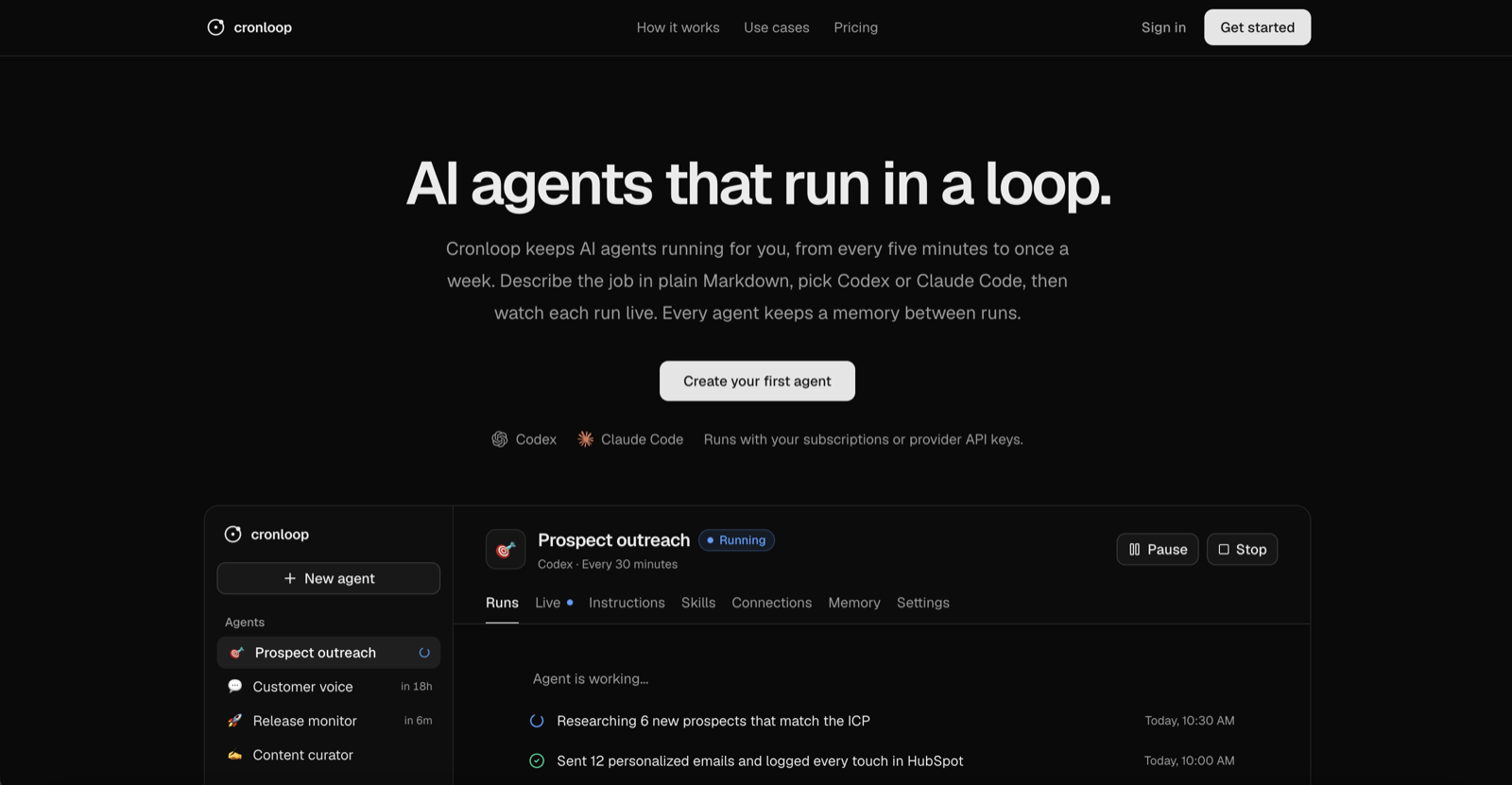
The agent runs on Cronloop, the sibling product I built alongside Cactal. Cronloop runs AI agents in a loop. You describe a job in plain Markdown, pick Claude Code or Codex as the engine, set a schedule anywhere from every five minutes to once a week, and watch each run live. Every run starts in a fresh isolated sandbox, and every agent keeps a memory between runs.
Another agent goes to work at 6am every morning on my screenshot API. I built it to do SEO: read the Search Console data, study competitors, refresh pages, publish new ones. The surprise was everything else it caught. One morning it noticed the pricing page was selling a feature tier the server never implemented. Another morning it traced an outage to an environment variable with a trailing newline. It once discovered that nine of my integration guides were telling users to install a competitor's abandoned package. Each time, it shipped the fix before I woke up.
I built Cronloop because I didn't trust the alternatives. There's been a wave of heavyweight general-purpose agent frameworks, like OpenClaw and Hermes, and the industry is genuinely excited about the idea behind them. But ask engineers how many actually have one running in production and the answer is almost none. They're sprawling vibe-coded codebases with real vulnerabilities, and a Swiss Army knife agent is mediocre at every job you give it. The one great idea buried in those systems is the heartbeat: an agent that runs on a schedule and remembers what it learns. You don't need the rest. A proven harness like Claude Code or Codex, a focused instruction set, the right tools, memory, and a loop. That's all Cronloop is, and it's enough.
The two products were made for each other. Cactal made every part of operating a website reachable by agents, and Cronloop is the natural driver on top: an agent on a loop, connected to the site's CMS, source code, and analytics over MCP. Content curation, SEO, upkeep. Anything a website needs on a recurring basis, an agent can now simply own.
Websites are just the use case closest to home. Give an agent a prospecting database and its own email inbox, run it every thirty minutes, and you have an autonomous SDR that researches prospects, writes personalized outreach, and replies to whatever lands in its inbox, around the clock.
Cronloop itself was mostly built by agents while I worked on Cactal. Over the years I've developed an architectural blueprint that coding agents work unusually well inside: strict structure, heavy guardrails, patterns that keep a codebase maintainable without me watching every commit. I handed that system to Codex and let it engineer most of the product in the background. The first thing I made wasn't code at all; it was the marketing site, because I wanted the problem and the promise nailed down before building the product. My own attention went to the parts that had to be right: run isolation and secure storage of the credentials agents use to connect to their tools.
It's live now, and free to start. My bet is that the future isn't one giant general-purpose agent; it's a fleet of specialized ones, each with its own instructions, tools, and memory, each excellent at a single job, running on a heartbeat. Anyone who works with agents long enough eventually has the thought: this would be powerful if it just happened automatically every day. Cronloop exists so that thought takes five minutes to act on.
Visit: cronloop.ai